MERV Rating Best For 14x36x4 Air Filters
Most homes running a 14x36x4 cabinet are using the wrong MERV rating right now. Some bought MERV 8 because it was the least expensive. Others jumped to MERV 13 because higher seemed safer. Both calls work for some households and create problems for others. The right pick depends on who lives in the house and what your HVAC system was built to push, not on the number that sits highest on the package. We've watched this play out across hundreds of thousands of installations, and the right answer almost always sits in the middle of the lineup once the household profile gets factored in.
TL;DR Quick Answers
14x36x4 Air Filters
For most homes, running a 14x36x4 air filter with MERV 11 strikes the right balance between particle capture and airflow. Step up to MERV 13 when anyone in the house deals with allergies, asthma, smoke exposure, or a compromised immune system. MERV 8 is only the right call when an older HVAC system shows airflow strain at higher ratings.
MERV 8: baseline households and older HVAC systems
MERV 11: pet households, mild allergies, modern variable-speed systems
MERV 13: asthma, severe allergies, smoke exposure, immunocompromised
Actual size: 13.5 by 35.5 by 3.63 inches
Replacement cadence: every 6 to 9 months for most homes
Top 5 Takeaways
A 14x36x4 air filter actually measures 13.5 by 35.5 by 3.63 inches, and that tolerance gap is what lets the filter seat in the cabinet without binding.
MERV 11 is the right default for the 14x36x4 size class because it captures pet dander, finer pollens, and mold spores without straining modern HVAC systems.
Step up to MERV 13 for households dealing with asthma, severe allergies, smoke exposure, or a compromised immune system, after confirming the blower can handle it.
Four-inch media filters last 6 to 9 months in average conditions, roughly 3 to 6 times longer than 1-inch filters at the same MERV rating.
Domestic manufacturing supports tighter quality control on pleat consistency and frame rigidity, which matters across a half-year service life.
What Size Is A 14x36x4 Air Filter, Really?
The number on the box is a nominal size, and the filter inside is smaller. A 14x36x4 air filter measures roughly 13.5 by 35.5 by 3.63 inches. That gap is intentional. The cabinet needs a slip room to seat the filter without binding under blower pressure.
The four-inch depth matters more than most homeowners realize. Deeper pleats pack more media surface area into the same cabinet footprint, which means the filter loads more slowly and lasts longer. After three months of normal household dust, a 1-inch filter has started choking off airflow, while a 4-inch filter at the same load still has reserve capacity to spare.
In our experience, these deeper housings show up most often paired with whole-home media cabinets from Trane, Lennox, Carrier, and Aprilaire. If you're working with a Trane system, the Trane filter size and model number guide walks through how cabinet model numbers map to filter dimensions. That single reference saves a return trip to the supplier when the size on the box does not match the slot.
MERV Ratings In Plain English
MERV stands for Minimum Efficiency Reporting Value. The rating system tells you what percentage of particles a filter captures at specific particle sizes. The scale runs 1 to 16 for standard residential and commercial filters, with hospital surgical suites and clean rooms running even higher ratings. Most residential systems work in the middle of the scale.
For a 14x36x4 air filter, you're realistically choosing between three ratings. MERV 8 catches the larger particles, including household dust, lint, large pollen, and carpet fibers. MERV 11 picks up where MERV 8 leaves off, adding pet dander, mold spores, and finer pollens to the catch. MERV 13 reaches into the ultrafine range, capturing bacteria, smoke particles, and respiratory droplets.
Higher numbers create more resistance to airflow, which is the reason the highest rating costs you more than just the price on the box. The same principle that governs any air filter applies here. Match the media to the particles you actually need to stop, with enough surface area to do that without choking your blower.
Match MERV To Your Household
The right MERV rating depends less on the filter and more on who lives in the house. Four household profiles drive the decision:
Baseline household, older HVAC system. No pets in the home, no allergy or asthma diagnoses, and a furnace or air handler that's been in service ten or more years. MERV 8 is the right pick. It captures dust, lint, large pollen, and carpet fibers without adding measurable resistance to a system that was never engineered for dense media. Replacement runs every 6 to 9 months in a 4-inch housing.
Pet household or mild seasonal allergies. One or more dogs or cats, kids who track outdoor pollen inside, or a family member who notices congestion during pollen seasons. MERV 11 captures pet dander, mold spores, dust mite debris, and finer pollens that MERV 8 lets pass. Most modern variable-speed systems handle MERV 11 in a 4-inch housing without static pressure problems. Replacement runs every 6 months in average conditions and every 3 to 4 months in heavy-shed households.
Asthma, severe allergies, smoke exposure, or an immunocompromised family member. Anyone in the house who manages a respiratory condition, the area sees wildfire smoke, or someone is recovering from illness or treatment that suppresses immunity. MERV 13 captures bacteria, smoke particles, ultrafine dust, and virus-carrying droplets. Verify your blower handles MERV 13 before ordering. Older single-stage furnaces with undersized returns can show airflow drop at this density. Replacement runs every 6 to 9 months, even at MERV 13, because the four-inch depth still gives the media room to load.
Active renovation or new construction. Drywall dust, sawdust, and finish particles flood the return air during the work. Run MERV 13 throughout construction, then settle back into MERV 11 once daily life resumes.
Florida humidity adds one more wrinkle for households along the Gulf or Atlantic coast. Damp loaded filters can support biological growth between scheduled changes, so the replacement interval matters more in humid climates than the package sticker suggests.
Replacement Cadence, Fit, And The Made In USA Question
A few practical considerations round out the decision before you order:
Replacement cadence by the numbers. A 4-inch media filter lasts roughly 3 to 6 times longer than a 1-inch filter at the same MERV rating. Most 14x36x4 filters hit their replacement point between 6 and 9 months. Humid climates load filters faster, especially during summer.
Fit before you order. Confirm your housing slot accepts a filter at 13.5 by 35.5 by 3.63 inches. Cabinet tolerances vary by an eighth of an inch between manufacturers, and a too-tight filter bows under blower pressure, while a too-loose one bypasses air around the edges instead of sending it through the media.
Made in the USA matters for quality control. Domestic manufacturing gives us tighter quality control on pleat consistency, gasket sealing, and frame rigidity. Frames need to hold their shape across a 6-to-9-month service life, and flimsy ones bow under static pressure long before the media is loaded.
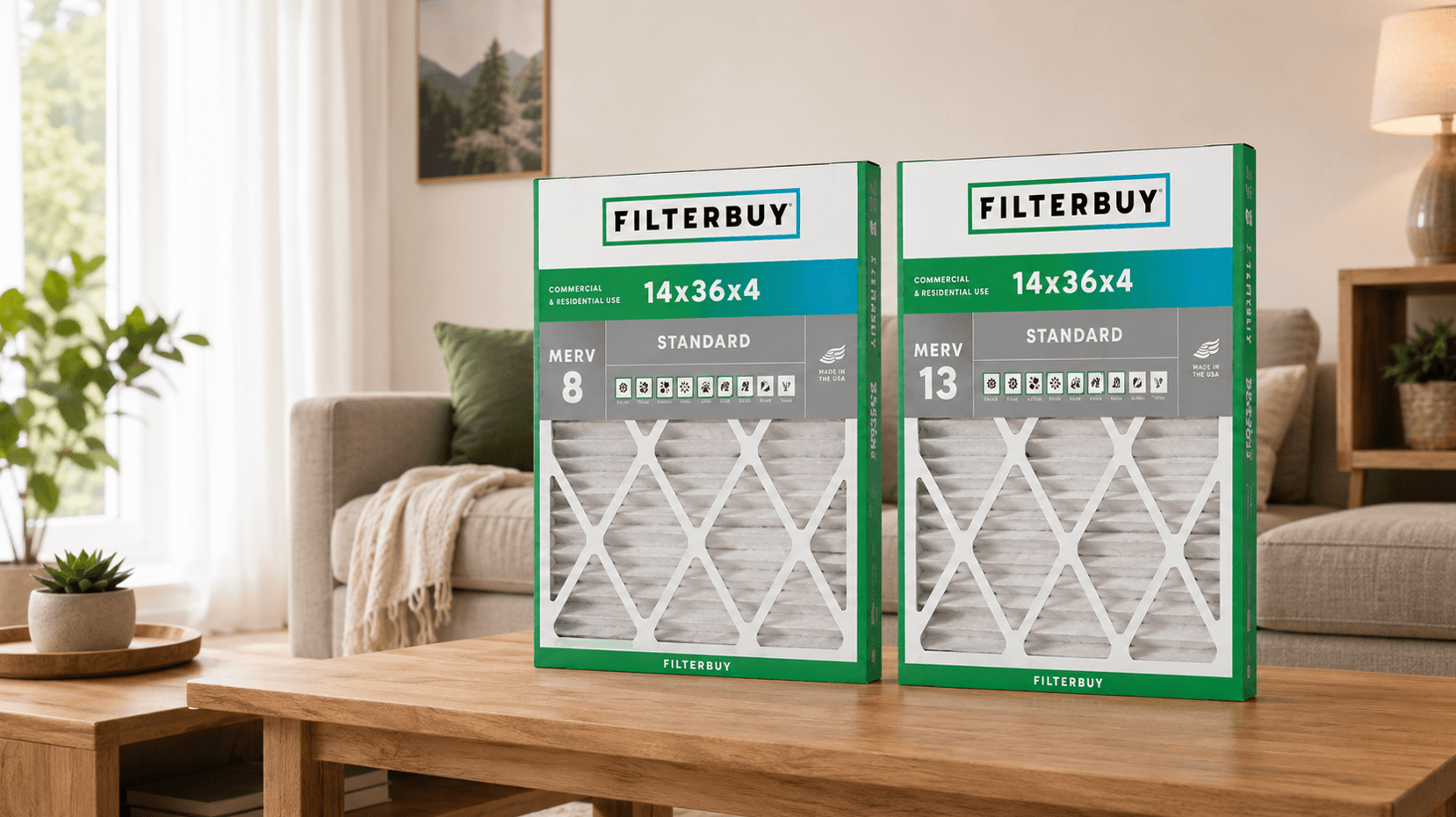
“After manufacturing filters for over a decade and helping millions of households, we've learned that the right MERV rating comes from looking at the people inside the house, rather than the numbers printed on the package. For a 14x36x4 housing, that usually lands at MERV 11 day-to-day, with MERV 13 when allergies, asthma, or smoke raise the stakes.”
Essential Resources On 14x36x4 Air Filters
The seven sources below back up the household-by-household guidance above with independent federal, clinical, and industry references. Each link points to a specific article, not a homepage. We've vetted every URL live before publishing.
1. Federal Guide To Choosing An Air Cleaner Or HVAC Filter For Your Home
The EPA's consumer-facing article on residential air cleaners and HVAC filters covers what particle filtration actually removes, where filtration fits alongside source control and ventilation, and what the agency does and does not endorse on filter brands.
Source: EPA Guide to Air Cleaners and Air Filters in the Home
2. Industry Filtration Standards And HVAC Compatibility Guidance
ASHRAE (pronounced ASH-ray) sets the technical standards that govern how filters are tested and rated. Their filtration and disinfection hub covers MERV testing methodology, residential recommendations, and how filter selection interacts with blower capacity.
Source: ASHRAE Technical Resources on Filtration and Disinfection
3. How Filter Changes Affect Energy Bills And HVAC Efficiency
The Department of Energy walks through the maintenance routine that keeps an air conditioner running efficiently across its service life, with filter replacement front and center. Useful framing for the energy side of the MERV decision.
Source: U.S. Department of Energy Air Conditioner Maintenance Guide
4. Clinical Perspective On Pet Dander And Household Allergen Exposure
The American Academy of Allergy, Asthma, and Immunology breaks down how pet allergens move through indoor environments. Direct relevance for anyone weighing MERV 11 against MERV 13 in a pet household.
Source: AAAAI Pet Allergy Patient Reference
5. Public Health Guidance On HVAC Filtration And Air Cleanliness
CDC NIOSH covers filtration as one of two primary methods for improving indoor air cleanliness. Their guidance points to MERV 13 or better as the upgrade target for central HVAC when the system can handle it.
Source: CDC NIOSH Guidance on Improving Air Cleanliness
6. Peer-Reviewed Research On Air Filtration And Indoor Allergen Removal
This open-access NIH study measured how air filtration affected dust mite, cat, and dog allergen levels across 22 real bedrooms. Direct evidence on what filtration changes in the homes that matter most.
Source: NIH PMC Study on Air Filtration and Indoor Allergen Removal
7. How MERV Ratings Are Tested And What The Numbers Actually Mean
The National Air Filtration Association breaks down residential air filtration from the testing perspective, including the depth and airflow constraints that shape filter selection. Helpful background for understanding why MERV 13 captures more than MERV 11 in measurable terms.
Source: NAFA Residential Air Filtration Reference Article
Supporting Statistics
These figures come from three independent U.S. public health and patient-advocacy sources, each on a different root domain from the resources above. Every figure and URL was confirmed live at the source before publishing.
1. Asthma Prevalence In The United States
In 2022, 26.8 million Americans, or 8.2% of the population, had been diagnosed with asthma and reported still having asthma.
In our experience, asthma households are the single clearest case for stepping up to a 14x36x4 filter up to MERV 13.
Source: American Lung Association Asthma Trends Brief
2. Allergic Conditions Affect More Than 106 Million Americans
More than 106 million people in the U.S. experience various types of allergies each year, or about 1 in 3 Americans.
Households at MERV 8 are the ones most likely to feel relief from upgrading to MERV 11, because finer pollens and mold spores are exactly what the higher rating catches.
Source: Asthma and Allergy Foundation of America Allergy Facts and Statistics
3. Pet Allergies Affect A Significant Share Of Allergy Sufferers
As many as 3 in 10 people with allergies in the United States have allergic reactions to cats and dogs, and cat allergies are roughly twice as common as dog allergies.
That ratio is why MERV 11 has become our default recommendation for the 14x36x4 size class. Pet dander is too small for MERV 8 to catch reliably.
Source: American College of Allergy, Asthma and Immunology Pet Allergy Overview
Final Thoughts And Opinion
Here is our position after watching this decision play out across hundreds of thousands of installations. MERV 11 is the right default for the 14x36x4 size class. The housing is already deep enough to support denser media without choking modern HVAC systems, and MERV 11 captures the particles that most households actually feel, including pet dander and finer pollens that MERV 8 lets through.
The case for stepping up to MERV 13 is health-driven. Asthma, smoke exposure, recent illness, or a household member with a compromised immune system are the conditions that justify the higher rating. The case for dropping to MERV 8 is system-driven, almost always older HVAC equipment that was never built for restrictive media.
Buy for the household you actually have. The right MERV rating follows from that single decision.
Frequently Asked Questions
Q: What is the actual size of 14x36x4 air filters?
A:
The Actual size of 14x36x4 air filters is roughly 13.5 by 35.5 by 3.63 inches.
The nominal label leaves a small gap so the filter seats in the housing without binding under blower pressure.
Confirm cabinet tolerance before ordering, especially when mixing brands between the cabinet and filter.
Q: Is MERV 13 too restrictive for residential HVAC?
A:
Most variable-speed and two-stage systems handle MERV 13 in a 4-inch housing without measurable pressure problems.
Older single-stage furnaces with undersized returns can show airflow drop at MERV 13.
Check the static pressure across the filter before committing if your system is more than 12 years old.
Q: How often should I replace a 14x36x4 filter?
A:
Average household conditions call for replacement every 6 to 9 months.
Heavy pet shed or wildfire smoke periods shorten the interval to every 3 to 4 months.
Humid coastal climates load filters faster, so plan closer to the 6-month end of the range.
Q: Can a 14x36x4 MERV 11 filter help with pet allergies?
A:
Yes. MERV 11 captures pet dander, mold spores, and dust mite debris that MERV 8 lets pass.
Run the HVAC fan in 'on' rather than 'auto' to keep air cycling through the filter.
Replace closer to every 3 to 4 months in heavy-shed households.
Q: Which MERV rating is best for homes with asthma?
A:
MERV 13 is the right choice for asthma, severe allergies, and immunocompromised households.
It catches the fine particles that aggravate respiratory conditions, including smoke and ultrafine dust.
Verify your blower handles MERV 13 before stepping up if your system is older.
Q: Are 14x36x4 filters made in the USA?
A:
Yes. Several manufacturers, including Filterbuy, produce 14x36x4 media filters domestically.
Domestic manufacturing gives us tighter quality control on pleat consistency and frame rigidity.
Check the box or product page for country-of-origin labeling before ordering.
Find The Right 14x36x4 Filter For Your Home.
Match a MERV rating to your household profile using the framework above, then check current stock and pricing by clicking or tapping here. Once you install it, we recommend setting a phone reminder for 6 to 9 months out, so the next decision happens on your schedule rather than your HVAC system's.
Learn more about HVAC Care from one of our HVAC solutions branches…
Filterbuy HVAC Solutions - West Palm Beach FL
1655 Palm Beach Lakes Blvd., Ste 1005 West Palm Beach, FL 33401
(561) 448-3760
https://maps.app.goo.gl/VarpgNZnxuPQuW8A7